
Data Engineer Technologies: Skills & Tools Guide
Learn essential skills, tools, and platforms to build data pipelines, manage cloud systems, and grow a future-ready career.
Vassud
5/26/20263 min read
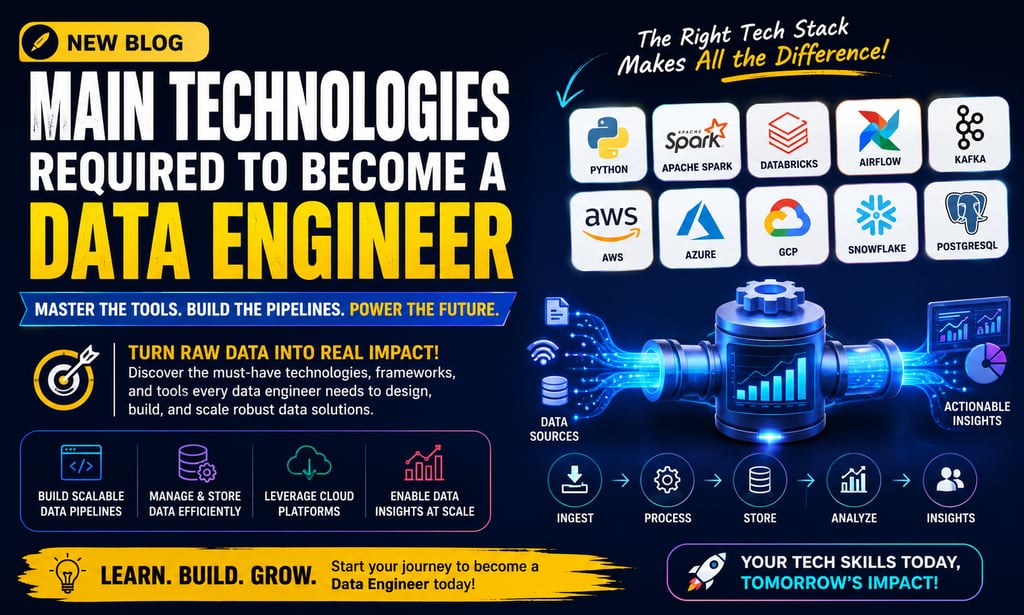
Main Technologies Required to Become a Data Engineer
Every modern business depends on information. When someone places an order online, watches a video, makes a payment, fills out a form, or clicks on an app, data is created. But raw information alone is not useful. It needs to be collected, cleaned, stored, and prepared before teams can use it for reports, dashboards, artificial intelligence, or business decisions. This is where data engineering becomes important. A professional in this field builds the systems that move information from different sources into trusted platforms. To start a strong career, you need the right mix of programming, databases, cloud platforms, big data tools, data warehousing, and workflow automation.
Why Data Engineering Skills Matter
Companies today do not want guesses. They want clear answers from reliable numbers. Marketing teams want to understand customers. Finance teams want accurate reports. Product teams want to know how users behave. Business leaders want faster insights. None of this works well without strong data pipelines. Data engineering skills help organizations move information safely and efficiently from apps, websites, APIs, transaction systems, and external tools into analytics platforms. When these systems are built properly, teams can trust the information they use every day.
Programming Languages for Data Pipeline Development
Python for Automation and Processing
Python is one of the most useful languages for anyone entering this field. It is simple to read, easy to learn, and powerful enough for real projects. Python helps automate repeated tasks, clean files, connect with APIs, and process large datasets. Libraries such as Pandas, NumPy, and PySpark make it easier to transform information and prepare it for analysis. Many companies use Python because it saves time and supports both small scripts and large production workflows.
SQL for Database Management
SQL is a must-have skill for working with structured records. It helps you search, filter, join, update, and organize information stored inside databases. Whether a company uses PostgreSQL, MySQL, SQL Server, BigQuery, Redshift, or Snowflake, SQL remains one of the most used skills in daily work. Strong SQL knowledge helps you understand business data, fix quality issues, and write better queries for reporting and analytics.
Big Data Technologies for Scalable Systems
Apache Spark for Large-Scale Processing
When information becomes too large for normal tools, big data technologies are needed. Apache Spark is popular because it can process massive datasets across multiple machines. It is used for batch processing, real-time analytics, and machine learning workflows. Learning Spark helps you understand how large companies handle logs, transactions, user activity, and high-volume business records.
Hadoop Ecosystem for Distributed Storage
Hadoop is another important technology for understanding large-scale systems. It helps store and process huge amounts of information across distributed servers. Tools such as HDFS, Hive, and MapReduce are part of this ecosystem. Even though many companies now use cloud-based platforms, Hadoop knowledge still gives you a strong foundation in how large data systems are designed.
Kafka for Real-Time Streaming
Some businesses need live updates instead of waiting for daily reports. Kafka helps move streaming information from apps, payment systems, sensors, websites, and other platforms into processing systems. It is commonly used for real-time dashboards, fraud detection, monitoring, and event-based applications. Knowing Kafka can help you work on fast-moving systems where fresh information matters.
Cloud Data Engineering Platforms
Cloud computing is now a core requirement in many technology roles. Companies prefer cloud platforms because they are flexible, scalable, and cost-effective. Amazon Web Services, Microsoft Azure, and Google Cloud provide services for storage, processing, workflow management, and analytics. Useful tools include Amazon S3, AWS Glue, Amazon Redshift, Azure Data Factory, Azure Synapse, Google BigQuery, and Google Cloud Storage. Learning cloud architecture helps you build pipelines that can grow with business needs.
Data Warehousing and ETL Tools
Snowflake, Big Query, and Redshift
Data warehousing helps companies store clean and organized information for reports and dashboards. Snowflake, Big Query, and Redshift are widely used platforms for analytics workloads. These tools help teams run fast queries, manage large datasets, and support business intelligence systems. Understanding data warehouse design can make your projects more practical and job-ready.
Airflow, dbt, Talend, and Informatica
ETL and ELT tools help move information between systems while keeping workflows organized. Apache Airflow is used for scheduling and monitoring pipelines. dbt helps transform information inside a warehouse using SQL-based workflows. Talend and Informatica are often used in enterprise environments. These tools make pipelines easier to manage, test, and maintain.
DevOps and Workflow Technologies
Modern teams also expect knowledge of Git, Docker, and Kubernetes. Git helps track code changes and supports teamwork. Docker helps package applications so they run consistently across systems. Kubernetes helps manage containers at scale. These tools are not only for software developers; they also help data teams deploy reliable workflows and maintain production systems.
Final Roadmap to Start
Begin with SQL and Python because they are the foundation. After that, learn databases, ETL concepts, and cloud storage. Once you are comfortable, move to Apache Spark, Airflow, Snowflake, Kafka, and real-world projects. Build small pipelines, document your work, and publish projects on GitHub. The goal is not to learn every tool at once. The goal is to understand how information moves from raw sources to useful insights. With consistent practice and the right technology stack, you can build a strong path toward a future-ready career in data engineering.
©2025 Vassud | Global Education & Career Consultancy | Study and Work Abroad with Confidence | All Rights Reserved