
NHS Jobs Trends and Advantages - Latest jobs
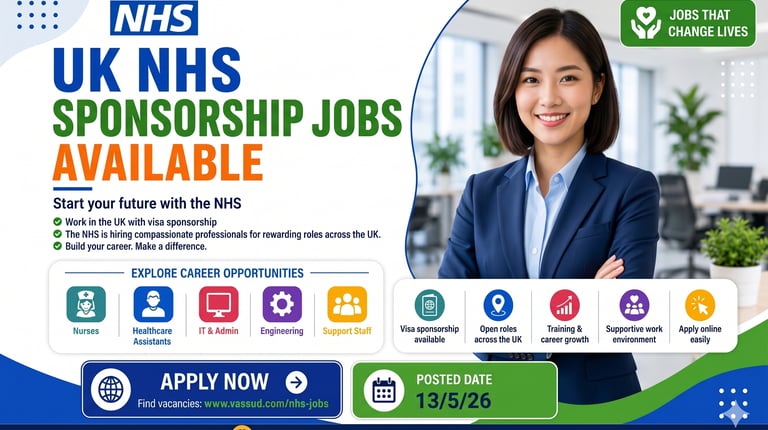
Discover exciting NHS job openings in a wide range of healthcare and professional fields with visa sponsorship opportunities. Build your future in the UK with stable, rewarding, and career-focused roles.
Vassud
5/13/20268 min read
NHS Jobs Trends and Advantages: Your Complete Career Guide for 2026
The National Health Service (NHS) is one of the largest employers in the world, offering hundreds of thousands of job opportunities across clinical, administrative, and technical roles. Whether you are a healthcare professional, a recent graduate, or someone considering a career change, understanding NHS job trends in 2026 can give you a significant advantage in the job market.
In recent years, NHS hiring has evolved rapidly — driven by digital transformation, post-pandemic workforce demands, and growing investment in primary and mental health care. Knowing where the opportunities lie and what employers are looking for helps you plan your career move with confidence and purpose.
This guide breaks down the current NHS job trends, the key advantages of working in the NHS, what you need to apply, and the practical steps to get started today.
What Are NHS Jobs?
NHS jobs are positions within the National Health Service — the publicly funded healthcare system of the United Kingdom. These roles span across hospitals, GP practices, community health centers, ambulance trusts, mental health services, and administrative offices throughout England, Scotland, Wales, and Northern Ireland.
Jobs range from doctors, nurses, and allied health professionals to IT specialists, finance officers, porters, caterers, and researchers. All NHS vacancies in England are advertised through the official NHS Jobs portal at jobs.nhs.uk, making it easy to search and apply in one centralized place.
With over 350 different career pathways and more than 1.5 million employees, the NHS is not just a healthcare provider — it is one of the most diverse and opportunity-rich employers in the United Kingdom.
Why NHS Careers Matter in 2026
Healthcare is not just a sector — it is the backbone of society. As the UK population ages and demand for services increases, the NHS needs more skilled, compassionate workers than ever before. For job seekers, this creates a rare and valuable combination: high job security, strong pay and benefits, and the satisfaction of doing meaningful work.
For international professionals, the NHS is one of the few major employers in the UK that actively recruits from abroad and holds a Skilled Worker sponsor license — making it one of the clearest pathways to working and living in the United Kingdom.
Whether you are early in your career or looking to transition, understanding NHS trends and how to position yourself effectively can make all the difference.
IT and Technical Jobs
👉 Senior Data Engineering Analyst
Current NHS Job Trends in 2026
NHS hiring patterns have shifted significantly, with several key trends shaping where demand is highest. Here is what you need to know:
1. Mental Health Roles Are Growing Fast
Following record demand post-pandemic, the NHS continues to expand its mental health workforce. Roles in high demand include therapists, psychiatrists, community support workers, psychological wellbeing practitioners, and IAPT (Improving Access to Psychological Therapies) practitioners. The NHS Long Term Plan has committed billions to mental health services, meaning this growth is set to continue for years.
2. Digital and Technology Jobs Are in High Demand
NHS digitization programs are creating thousands of new roles in health informatics, clinical data analysis, cybersecurity, and electronic health record (EHR) management. If you have a background in IT, data, or technology, the NHS is actively looking for professionals to help modernize its systems.
3. Nursing and Midwifery Shortages Remain Critical
The NHS continues to recruit internationally for registered nurses, midwives, and healthcare assistants. Many trusts are offering relocation packages, accommodation support, and direct visa sponsorship to attract qualified candidates from overseas. If you are a nurse registered outside the UK, this is one of the most accessible routes into NHS employment.
4. Primary and Community Care Expansion
GP practices, district nursing services, and community pharmacies are receiving major investment, creating more roles closer to patients' homes. This includes social prescribers, pharmacists, physician associates, and care coordinators — many of which are brand-new role categories within primary care.
5. International Recruitment with Visa Sponsorship
The NHS holds a Tier 2 / Skilled Worker sponsor license and actively recruits from overseas, particularly for clinical roles listed on the UK Shortage Occupation List. This includes reduced visa fees, faster processing, and exemption from the income threshold requirement in some cases.
Benefits and Advantages of Working for the NHS
NHS employment comes with a package that is difficult to match in the private sector. Here are the key advantages:
Generous Pension Scheme
NHS employees benefit from one of the most valuable defined benefit pension schemes in the United Kingdom. Employer contributions are up to 20.6%, and the scheme provides a guaranteed income in retirement based on your salary and years of service — not market performance.
Excellent Annual Leave Entitlement
Starting at 27 days per year (plus 8 bank holidays), annual leave rises to 33 days with length of service. This is significantly above the UK average and is maintained consistently across all NHS trusts under the Agenda for Change framework.
Clear Career Progression
The NHS Agenda for Change pay bands (1 to 9) provide a transparent, structured framework for pay progression and promotion across all non-medical roles. You always know what the next step is and what it takes to get there.
Learning and Development Support
NHS staff have access to funded training, e-learning platforms, apprenticeships, secondments, and study leave. Whether you want to specialize clinically or move into management, the NHS actively invests in your development.
Job Security and Stability
As a public sector employer, the NHS offers long-term employment stability, robust employment rights, and strong union representation through bodies like the Royal College of Nursing (RCN), Unison, and the British Medical Association (BMA).
Flexible Working Options
Many NHS roles are available part-time, on job-share arrangements, or with flexible shift patterns. The NHS has a statutory duty to consider flexible working requests, making it one of the more family-friendly large employers in the UK.
Meaningful, Purpose-Driven Work
Working for the NHS means contributing directly to patient care and public health. It is consistently rated as one of the most fulfilling career paths in the UK, with strong community and team-based culture across most departments and trusts.
Requirements and Eligibility for NHS Jobs
The requirements for NHS jobs vary greatly depending on the role, but here is a general overview of what you will typically need:
Qualifications: Range from GCSEs and A-Levels for support and administrative roles, to Bachelor's or Master's degrees for clinical, specialist, and management positions.
Right to Work in the UK: You must have UK citizenship, EU settled status, or a valid Skilled Worker Visa. The NHS can sponsor eligible applicants for clinical roles on the Shortage Occupation List.
DBS Check: Most NHS roles require an Enhanced Disclosure and Barring Service (DBS) clearance. This is arranged by the employer once an offer is made.
Occupational Health Screening: Clinical roles often require proof of vaccinations including Hepatitis B, MMR, Tuberculosis, and seasonal flu, as well as a general fitness-to-work assessment.
Professional Registration: Nurses need NMC (Nursing and Midwifery Council) registration. Doctors need GMC (General Medical Council) registration. Allied health professionals need HCPC (Health and Care Professions Council) registration. Most clinical roles require valid UK registration before starting.
English Language Proficiency: International applicants whose first language is not English may need to provide IELTS Academic or OET scores. Clinical roles typically require a score of 7.0 or above in each component of IELTS.
References: Most NHS employers require two professional references covering the last three years of employment.
How to Start Your NHS Career: Step-by-Step
Follow these steps to move from interest to employment as efficiently as possible:
Identify the Right Role for You
Browse by job category, location, pay band, or trust. Use keyword filters to narrow down roles that match your qualifications, experience, and career goals. You can also set up email job alerts so you are notified as soon as a matching vacancy is posted.Create Your NHS Jobs Account
Register on the NHS Jobs portal. Your profile stores your application history, personal statement library, and equal opportunities information. A complete profile makes future applications faster and more consistent.Tailor Each Application Carefully
Read the job description and person specification carefully for every role you apply to. Your supporting statement must address each essential and desirable criterion using specific, real-life examples. Generic applications rarely succeed at NHS shortlisting stage.Prepare for Assessment and Interview
Many NHS roles include online situational judgement tests, values-based interview questions, and practical assessments. Research the NHS Constitution and its six core values before attending any interview: working together, respect and dignity, commitment to quality, compassion, improving lives, and everyone counts.Obtain Registration and Credentials in Advance
If your role requires professional registration (NMC, GMC, HCPC), begin the registration process as early as possible — especially if you are applying from overseas, as this can take several months.Complete Pre-Employment Checks
Once a conditional offer is made, you will be required to complete an Enhanced DBS check, provide professional references, attend occupational health screening, and verify your right to work. Preparing these documents in advance can significantly shorten the time between offer and start date.
5 Tips for NHS Application Success
Here is actionable advice you can apply immediately to improve your chances of getting shortlisted and hired:
Use the Person Specification as Your Checklist
Every bullet point in the "essential criteria" section must appear in your supporting statement — ideally backed by a specific, real example. If a criterion is missing from your statement, you will almost certainly be rejected at shortlisting stage.Reference NHS Values Explicitly
Use language that mirrors NHS values — phrases like "compassionate care", "respect and dignity", "commitment to quality improvement", and "working collaboratively across teams". Interview panels score candidates directly against these values, so embedding them naturally into your answer’s matters.Apply Early and Set Job Alerts
Many NHS roles close as soon as a sufficient number of applications are received — sometimes days after posting. Set up job alerts on NHS Jobs so you never miss a vacancy that matches your profile.Get Your Documents Ready Before You Apply
DBS checks, occupational health forms, and reference requests can delay your start date by weeks if not prepared in advance. Have your documents — including passport, professional registration certificates, and reference contacts — ready to submit immediately after receiving an offer.
Ready to Take Your Next Step?
The NHS is hiring right now — across clinical, administrative, digital, and support roles throughout the UK. Here is how to take action today early notice of upcoming vacancies.
NHS Clinical Jobs
👉 Senior Community Staff Nurse (Carlisle Healthcare)
👉Senior Psychological Wellbeing practitioner
Frequently Asked Questions
1. Do I need previous NHS experience to apply?
Not necessarily. Many entry-level and support roles do not require prior NHS experience. What matters most is demonstrating the NHS values and showing transferable skills from other work, volunteering, or personal experience. Clinical roles will require relevant professional experience and registration.
2.Can international applicants apply for NHS jobs?
Yes. The NHS actively recruits internationally and holds a Tier 2 Skilled Worker sponsor licence. Clinical roles such as nursing, medicine, and allied health professions are commonly on the Shortage Occupation List, which can make visa applications easier and faster. Many trusts also offer relocation support packages.
3.How long does the NHS recruitment process take?
Typically 4 to 8 weeks from application to job offer, followed by another 4 to 8 weeks for pre-employment checks. Clinical roles from overseas can take longer due to professional registration and visa processing timelines.
4.Are there part-time or flexible working options in the NHS?
Yes. The NHS has a statutory duty to consider flexible working requests. Many roles are advertised as part-time, job-share, or with flexible shift patterns — particularly in nursing, administrative, and community-based positions.
5.What is Agenda for Change (AfC)?
Agenda for Change is the NHS pay framework used for the majority of non-medical staff. It divides roles into pay bands 1 to 9, each with defined pay points that increase annually. It ensures consistency and transparency in how staff are paid and progress throughout their careers.
6. Is experience needed to get a Band 5 or Band 6 NHS role?
Band 5 roles (such as newly qualified nurses or junior physiotherapists) typically require a relevant degree and professional registration but not extensive post-qualification experience. Band 6 roles usually require at least one to two years of post-registration experience and evidence of specialist skills or leadership ability.
7.Can I switch career fields and join the NHS?
Absolutely. The NHS employs professionals from finance, IT, HR, communications, facilities management, and many other sectors. Career changers who bring strong transferable skills and a genuine commitment to NHS values are welcomed across non-clinical departments.
Conclusion
NHS careers in 2026 offer more than just a job — they offer purpose, stability, and a clear pathway to long-term professional growth. Whether you are newly qualified, switching sectors, returning to work, or an international healthcare professional seeking a new beginning in the UK, the NHS has a place for people who share a commitment to care and service.
The job market is competitive, but it is navigable. Start with the right role in mind, build a tailored application, understand what recruiters look for, and take practical steps from application right through to onboarding. The biggest advantage you can have is simply being informed and prepared
Success comes from taking the right steps consistently. Start early, stay informed, and keep improving — both your skills and your applications.
©2025 Vassud | Global Education & Career Consultancy | Study and Work Abroad with Confidence | All Rights Reserved