
NHS Personal Statement vs Supporting Information: What You Need to Know Before You Apply
Many NHS applicants think personal statement and supporting information differ. Learn what each means, how recruiters score it, and how to get shortlisted.
6/25/20267 min read
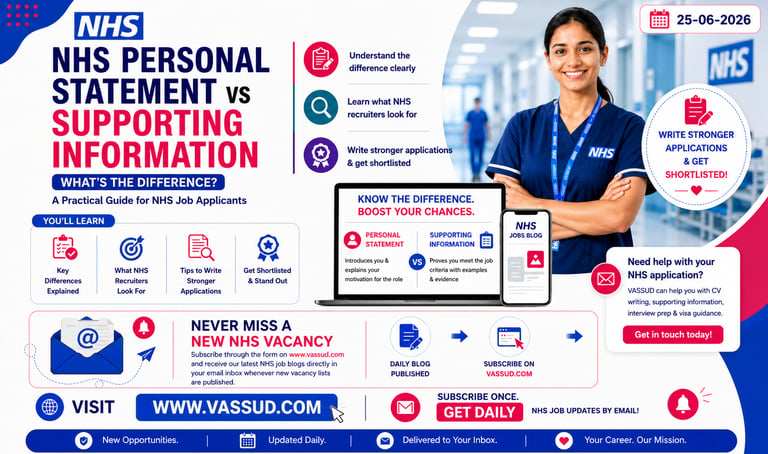
NHS Personal Statement vs Supporting Information
What's the Difference? A Practical Guide for NHS Job Applicants
If you've started an NHS Jobs or Trac application, you've probably hit a moment of confusion. The form asks for “supporting information.” But every blog, forum, and friend who got a job keeps calling it a “personal statement.” Are they the same thing? Different things?
This mix-up trips up thousands of applicants every month, especially international candidates new to UK recruitment systems. Get it wrong, and you could submit an application that reads like a vague cover letter instead of proof that you meet the job criteria — one of the most common reasons strong candidates never get shortlisted.
Here's the short answer: “personal statement” and “supporting information” usually refer to the same box on the application form. But they're not identical in meaning, and the differences will change how you write your application. Let's break it down.
What Is a Personal Statement in an NHS Job Application?
A personal statement is the part of your application where you introduce yourself, explain your motivation, and describe your career story in your own words.
Think of it as the “why.” Why this role? Why this Trust? Why now?
In most NHS contexts, “personal statement” is used informally to describe the opening of your supporting information — where you talk about your background and how your values line up with the NHS Constitution. It's not usually a separate text box on NHS Jobs or Trac; it's a style of writing, not a different form field.
What Is Supporting Information in an NHS Job Application?
Supporting information is the official term used across NHS Jobs and Trac. It's the actual text box on the application form, and it's where shortlisting decisions are made.
It's broader and more evidence-based than a personal statement. Its job is to prove, point by point, that you meet the essential and desirable criteria in the person specification attached to the job advert.
This is the part recruiters actually score. Applications are assessed using a scoring system based on the requirements in the person specification, so you need examples of how you've met those requirements to score well.
So while a personal statement might explain your motivation in two or three sentences, supporting information needs to cover:
Each essential criterion, with evidence
Each desirable criterion you can reasonably address
Specific examples, not general claims
Clear writing a busy recruiter can scan quickly
In short: your personal statement is the introduction. Your supporting information is the whole document — that introduction plus the evidence that gets you shortlisted.
NHS Personal Statement vs Supporting Information: Key Differences
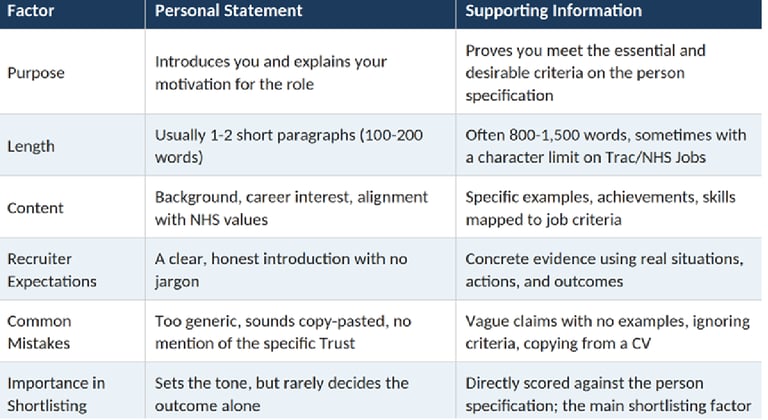
Here's a side-by-side comparison to make the distinction clear.
The takeaway: a polished personal statement opens the door, but it's your supporting information that decides whether you walk through it.
Which Section Matters More to NHS Recruiters?
Supporting information matters more, by a wide margin.
NHS Jobs and Trac shortlisting runs on a scoring system. Hiring managers review your application against the person specification and typically score each criterion individually. If your supporting information doesn't address a criterion, you often score zero for it, no matter how good your personal statement sounds.
This is also why shortlisting on Trac is usually done “blind” — hiring managers only see your employment history, supporting statement, qualifications, and training, not your photo or anything else that could introduce bias. Your supporting information is doing almost all the talking on your behalf.
A warm personal statement helps you sound human. But if the evidence that follows doesn't prove things like “experience managing competing priorities,” you're unlikely to be shortlisted, even with a beautiful opening paragraph.
Latest NHS Job Roles with Visa Sponsorship
Here’s a list of some of the latest NHS job roles that come with visa sponsorship:
NHS Clinical Jobs
👉 Research Midwife
👉 Research Nurse
👉 Assistant Psychologist/ Research Assistant
👉 Specialist Physiotherapist
IT and Technical Jobs
👉 Reporting Analyst
👉 Technical Analyst
👉 Digital Systems Analyst/Digital Systems Clinical Analyst
👉 Senior Data Engineer
👉 Senior Interface Analyst/Developer
👉 IT Integration Engineer
How NHS Recruiters Evaluate Supporting Information
Recruiters aren't reading for style. They're reading for proof. Here's roughly how the evaluation works:
1. They open the person specification first. This lists essential and desirable criteria, often as bullet points.
2. They scan your supporting information for matching evidence. If a criterion says “experience handling sensitive patient data,” they look for a sentence that proves exactly that.
3. They score each criterion, often against a scoring matrix you never see.
4. They rank applicants by total score, then decide who gets an interview slot.
This is why structure matters. Many successful applicants write their supporting information using job specification subheadings, then answer each one directly. If the advert lists “Communication Skills,” a strong response uses that exact phrase as a mini-heading, followed by a specific example.
Common Mistakes Applicants Make
These mistakes show up again and again in NHS application reviews, and they're avoidable once you know what to look for.
Copying and pasting from a CV: A CV lists what you did. Supporting information explains how and why it matters to this job. Pasting CV chunks also tends to create messy formatting, since NHS Jobs doesn't support much text styling.
Listing buzzwords with no evidence: Saying “I am responsible for service improvement” without describing what improved gives a recruiter nothing concrete to score.
Ignoring the person specification: A surprisingly common failure is missing the basic point that supporting information should link back to the published specification, even though most adverts state this plainly.
Reusing a previous application without updating details: Mentioning the wrong Trust name signals carelessness immediately.
Spelling and grammar errors: Healthcare roles attract close scrutiny here; typos suggest the same lack of attention might carry into clinical work.
Writing far too little, or far too much: A two-line response looks uninterested. An unstructured essay with no headings makes a recruiter give up halfway through.
Not addressing every essential criterion: Even one missed point can cost you a shortlisting opportunity, since some Trusts treat essential criteria as pass/fail
Tips for Writing Strong NHS Supporting Information
Start with the person specification, not a blank page: List every essential and desirable criterion before writing a single sentence.
Use the criteria as subheadings: This makes your document scannable for a recruiter reviewing dozens of applications in one sitting.
Apply the STAR method to every example: Situation, Task, Action, Result. Keep each one tight — three or four sentences is enough.
Mention the specific Trust by name: A line referencing a Trust's actual values shows genuine interest rather than a recycled template.
Keep your introduction short: One or two sentences on your background is plenty before you move into evidence.
Address employment gaps directly: A brief, honest sentence is far better than silence.
Check the word or character limit first: Writing first and trimming later wastes time.
Proofread away from the screen: Reading aloud, or printing it, catches errors that scanning on-screen often misses.
How International Applicants Can Improve Their NHS Applications
International applicants face a few specific hurdles, worth addressing head-on.
Translate your experience into NHS terms: A role title or clinical system from your home country might not mean anything to a UK recruiter. Explain unfamiliar terms in plain English.
Be explicit about registration and visa status: If you hold GMC, NMC, HCPC, or another registration, state it clearly and early. If you need sponsorship, say so; most Trusts ask directly, and an unclear answer causes delays later.
Avoid direct translation from your first language: Idioms that work well in another language can read oddly in English. Simpler, shorter sentences usually communicate more clearly.
Reference UK-specific frameworks where relevant: Mentioning the NHS Constitution or local safeguarding practices, where genuinely applicable, signals familiarity with UK healthcare.
Don't undersell international experience: A hospital abroad may run differently, but skills like patient assessment and clinical decision-making transfer directly. State this plainly.
Frequently Asked Questions
1. Is the NHS personal statement the same as supporting information?
In most NHS applications, yes. There isn't usually a separate “personal statement” box — the term describes the introductory part of your supporting information, the field actually scored during shortlisting.
2. How long should NHS supporting information be?
Length varies by Trust, but many recruiters suggest 800 to 1,500 words, or whatever the character limit allows on Trac. Quality of evidence matters more than hitting a maximum count.
3. What should I include in NHS supporting information?
Address every essential and desirable criterion from the person specification, using specific examples from your work, education, or volunteering. State the situation, what you did, and the result.
4. Can I copy my CV into the supporting information section?
No. Supporting information should explain and evidence your experience against the job criteria, not repeat your employment history, which is already captured elsewhere on the form.
5. Does the NHS shortlisting process check spelling and grammar?
Yes. Errors are noted by recruiters and can affect how your application is perceived, particularly for clinical and administrative roles where accuracy matters.
6. What is the NHS shortlisting process based on?
Shortlisting is based on scoring your application against the essential and desirable criteria in the person specification, usually carried out without recruiters seeing identifying details, to keep the process fair.
7. How do I write supporting information if I have employment gaps?
Address the gap briefly and honestly, for example noting a career break, further study, or relocation, rather than leaving it unexplained.
8. What's the best structure for NHS supporting information?
A short introduction followed by subheadings that match the person specification criteria, each backed by a specific example using the STAR method, tends to perform best with recruiters.
9. Do international applicants need to write supporting information differently?
Not fundamentally, but they should clearly state registration and visa status, explain unfamiliar terms in plain English, and confidently connect overseas experience to UK role requirements.
Conclusion
The confusion between “NHS personal statement” and “supporting information” is understandable, but now you know the real picture: they're closely linked, with supporting information being the official, scored section that decides whether you're shortlisted, and the personal statement simply being the introductory style used within it.
Getting this right means structuring your application around the person specification, backing every claim with real evidence, and writing clearly enough that a busy recruiter can score you fairly.
Small details, like addressing gaps honestly or naming the Trust specifically, often make the difference between a rejection and an interview invite.
©2025 Vassud | Global Education & Career Consultancy | Study and Work Abroad with Confidence | All Rights Reserved