
NHS Recruitment Process for UK and Overseas Applicants
Learn the NHS recruitment process for UK and overseas applicants, including applications, supporting information, interviews, DBS checks, visa sponsorship, and hiring steps.
Vassud
5/19/20264 min read
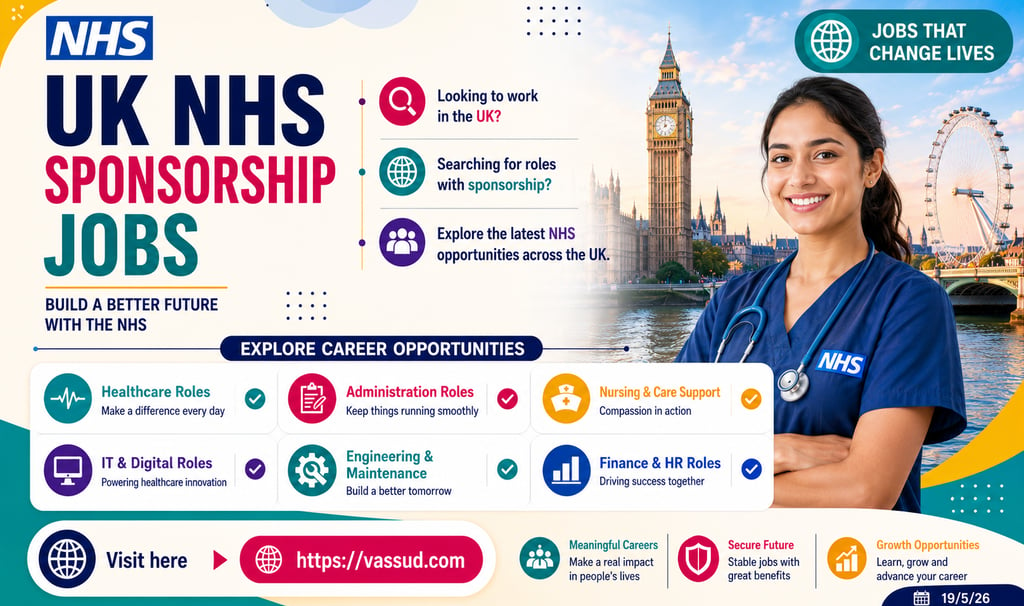
NHS Recruitment Process for UK and Overseas Applicants
NHS Jobs (jobs.nhs.uk) is the official, centralised recruitment platform for the National Health Service in England. It is the primary gateway through which NHS trusts, hospitals, GP practices, mental health services, ambulance services, and community health organisations advertise vacancies — from band 2 healthcare assistants right through to band 9 directors and medical consultants.
Unlike commercial job boards, NHS Jobs is purpose-built for healthcare recruitment. Every application goes through a standardised process aligned with NHS employment policies, equality standards, and the Agenda for Change (AfC) pay framework. Scotland, Wales, and Northern Ireland have their own equivalent portals (NHS Scotland, NHS Wales Jobs, and HSC Recruit), but the principles are largely identical.
💡 Did you know? NHS Jobs receives over 1 million job applications per month, making it one of the busiest public sector recruitment platforms in Europe.
Why It Matters — and Why Now
The NHS is facing a significant staffing challenge. Post-pandemic demand, an ageing population, and workforce shortages across nursing, allied health professions, and primary care mean that recruitment is at an all-time high. For job seekers, this represents a genuine and lasting window of opportunity.
Beyond job security, working for the NHS means entering a highly structured career ecosystem with transparent pay bands, protected rights, and meaningful public service. For overseas applicants, NHS employers are among the most active visa sponsors in the UK.
Understanding how to navigate NHS Jobs properly — how to search, how to write your supporting information, and how the application process works — can be the difference between getting shortlisted and being overlooked, even with strong qualifications.
Benefits of Working for the NHS
Joining the NHS is not just about a job — it's joining one of the most comprehensive employment packages in the UK public sector.
comprehensive employment packages in the UK public sector.
🏥Defined Pay Structure
Agenda for Change bands (2–9) provide transparent, predictable pay scales with annual increments.
💼NHS Pension Scheme
One of the most generous employer pension schemes in the UK, with significant employer contributions.
📈Career Development
Access to funded training, CPD hours, leadership programmes, and internal promotion pathways.
🌍Visa Sponsorship
Many NHS trusts hold Skilled Worker visa licences, making it a top route for international applicants.
🕐Flexible Working
Part-time, job-share, and flexible shift patterns are widely available across many roles.
🎓Staff Discounts
Blue Light Card, retail discounts, gym memberships, and cycle-to-work schemes for all NHS staff.
NHS Clinical Jobs
👉Clinical Intelligence and Assurance Co-ordinator
👉Health Care Assistant - Ward 3A Plastics (B3)
👉Specialist Medical Engineering Technician
👉Healthcare Assistant - Respiratory 6C
IT and Technical Jobs
👉Senior Data and Information Analyst- CYPMHS Provider Collaborative
👉Data & Information Administrator
👉Principal Engineer - Electrical
👉Engineering Tradesperson Electrical
👉Advanced Engineer - Mechanica
👉Specialist Information Analyst
Requirements & Eligibility
Eligibility varies by role, but the following table outlines what is commonly expected across the main NHS job categories:
All roles require a satisfactory DBS (Disclosure and Barring Service) check. Clinical roles also require Occupational Health clearance and proof of vaccinations (including hepatitis B).
How to Apply — Step by Step
Create Your NHS Jobs Account Visit jobs.nhs.uk and register. Complete your profile fully — this becomes the foundation of every application you submit on the platform.
Search and Filter Vacancies Use filters for job title, location, pay band, contract type (permanent, bank, fixed-term), and trust. Save your search to receive email alerts for new postings.
Read the Job Description Carefully Pay particular attention to the Person Specification — this lists the Essential and Desirable criteria. Your application must explicitly address every essential criterion.
Write Your Supporting Information This is the most critical part. Use the STAR method (Situation, Task, Action, Result) to demonstrate how you meet each criterion listed in the Person Specification. Aim for 600–1,000 words.
Submit and Track Your Application Submit before the closing date — late applications are not accepted. You can track your application status in your account dashboard.
Prepare for Interview NHS interviews are often structured (values-based or competency-based). Research NHS values (Care, Respect, Commitment to Quality, Compassion, Inclusion, Working Together) and prepare examples aligned to them.
Complete Pre-Employment Checks Once offered a role, you'll go through DBS, reference checks, Occupational Health, right-to-work verification, and (if applicable) professional registration confirmation.
5 Tips to Stand Out on NHS Jobs
Mirror the Person Specification. Copy each essential criterion and write a paragraph proving you meet it. Shortlisting is a tick-box exercise — if it's not written, it's not counted.
Tailor every application. Do not copy and paste between roles. Each job description is different, and generic applications are easy to spot and easy to reject.
Set up job alerts early. Popular NHS roles fill quickly. Having alerts set to your criteria means you apply in the first 24–48 hours of a vacancy being posted.
Get your references ready. NHS employers require references going back 3–5 years. Always seek permission from referees in advance and make sure they know to respond promptly.
Consider bank or voluntary work first. If you're new to the NHS or returning after a gap, getting bank work (temporary shifts) through an NHS trust is an excellent way to build experience and internal visibility before applying for permanent roles.
FAQ's
Can I apply for NHS jobs from outside the UK?
Yes. International applicants can apply, especially for healthcare roles, but they may need UK registration and English language proof.
How long does NHS recruitment take?
It usually takes 4–16 weeks, depending on the role. International applications with visa sponsorship may take longer.
Is a DBS check required for NHS roles?
Yes. Most NHS jobs need a DBS check, especially roles involving patients or vulnerable people.
Can I apply without NHS experience?
Yes. Many entry-level roles accept applicants with transferable skills like teamwork, communication, and care experience.
Do I need a specific CV format?
Not always. NHS applications usually use online forms, and the supporting information section is very important.
Can agency staff apply for permanent NHS roles?
Yes. Agency and bank staff can apply for permanent NHS roles and may already have useful NHS experience
Conclusion
The NHS offers stable, rewarding career opportunities for UK and international applicants. Success depends on matching your skills to the job requirements, preparing strong supporting information, and showing genuine care, commitment, and NHS values
©2025 Vassud | Global Education & Career Consultancy | Study and Work Abroad with Confidence | All Rights Reserved