
NHS Band 2 vs Band 3 — Pay, Responsibilities and Differences (2026)
Confused between NHS band 2 and band 3? Compare pay rates, job responsibilities, and career progression to decide which role is right for you.
Vassud
6/8/20265 min read


NHS Band 2 vs Band 3 — Differences in Pay, Responsibilities and Career Progression (2026)
If you are applying for NHS jobs and trying to decide between a band 2 and band 3 role, understanding the differences in pay, responsibilities, and career prospects is essential before you submit your application. While both bands sit at the entry level of the NHS Agenda for Change pay structure, there are meaningful distinctions that affect your day-to-day work, your earning potential, and your long-term career path within the NHS.
This guide breaks down everything you need to know about NHS band 2 versus band 3, including current pay rates, typical job roles at each band, the level of responsibility involved, and how each band connects to progression opportunities further up the Agenda for Change structure.
What Is the NHS Agenda for Change Pay Structure?
The NHS Agenda for Change framework is the pay system used for the majority of NHS staff in England, Wales, and Northern Ireland. It organises roles into bands from band 1 through to band 9, with each band carrying a defined salary range and set of responsibilities. Band 1 covers the most basic entry-level roles, while band 9 covers the most senior leadership positions. Bands 2 and 3 sit at the foundation of this structure and are the most common entry points for people starting their NHS career.
NHS Band 2 Pay Rate 2026
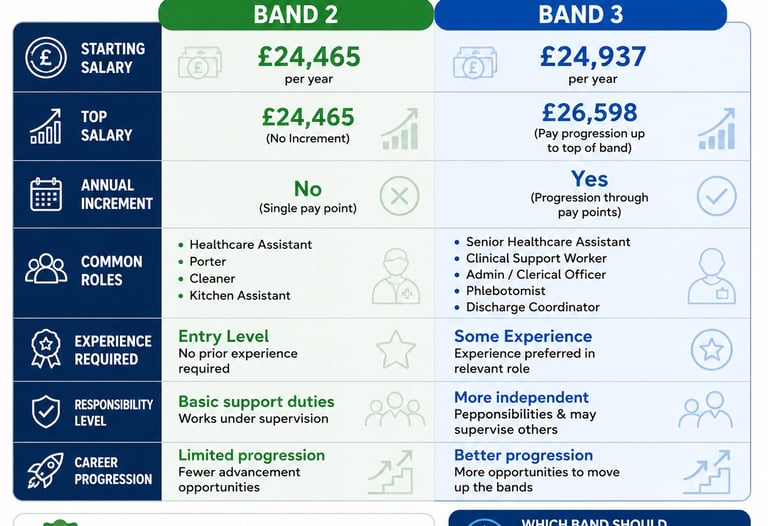
As of 2026, the NHS band 2 salary in England sits at approximately £23,615 per year. This is the standard rate for a full-time band 2 employee. Part-time roles are paid on a pro-rata basis. Band 2 staff typically receive incremental pay progression within the band based on length of service, subject to satisfactory performance.
It is worth noting that pay rates differ slightly in Scotland and Wales due to separate Agenda for Change negotiations in those nations. Always check the specific pay rate on the job advert for the trust you are applying to.
NHS Band 3 Pay Rate 2026
The NHS band 3 salary in England for 2026 starts at approximately £24,071 and progresses to around £25,674 at the top of the band. The higher starting salary at band 3 reflects the additional responsibilities, greater autonomy, and often the requirement for specific qualifications or prior NHS experience that band 3 roles carry.
For someone moving from band 2 to band 3 within the NHS, the pay increase may appear modest on paper, but the career development opportunities and increased scope of practice that come with band 3 make the progression significantly valuable beyond the salary difference alone.
NHS Band 2 vs Band 3 — Pay Comparison at a Glance
Typical NHS Band 2 Job Roles and Responsibilities
Band 2 roles are designed for individuals who are new to the NHS or working in a support capacity under close supervision. The work is generally routine and follows clearly defined procedures. Typical band 2 roles include healthcare support worker, ward housekeeper, porter, receptionist, and clerical support officer.
Key Responsibilities at Band 2
Assisting qualified clinical staff with basic patient care tasks such as washing, feeding, and mobility support.
Maintaining cleanliness and hygiene standards in clinical and non-clinical areas.
Greeting patients and visitors, managing appointment bookings, and handling general enquiries.
Transporting patients, equipment, and supplies within the hospital setting.
Completing basic administrative tasks under the direction of a line manager or senior colleague.
At band 2, the level of independent decision-making is limited. Most tasks are carried out following established protocols with regular oversight from a more senior member of staff.
Typical NHS Band 3 Job Roles and Responsibilities
Band 3 roles require a greater degree of skill, knowledge, and independence than band 2. Staff at this level are expected to manage their own workload within defined boundaries, take on more complex tasks, and sometimes provide guidance to band 2 colleagues. Typical band 3 roles include senior healthcare support worker, medical receptionist, senior administrator, pharmacy technician assistant, and theatre support worker.
Key Responsibilities at Band 3
Carrying out clinical or administrative tasks with a greater degree of autonomy and less direct supervision.
Supporting the induction and day-to-day guidance of band 2 staff and new starters.
Managing more complex patient or service user interactions that require judgement and problem-solving.
Maintaining accurate records, managing databases, or coordinating schedules with minimal oversight.
Contributing to service improvement initiatives within the team or department.
Clinical Roles
👉Receptionist - Emergency Department
👉Static Physiotherapist
👉MSK Clinical and Operational Manager
👉Clinical support Specialist - Homeless Care Coordinator
IT Roles
👉Information Analyst - Data Warehouse and Analytic
👉Junior Infrastructure and Cloud engineer
👉ICT Senior Database Administrator
👉Information Analyst - Data Warehouse and Analytics
👉Capital Projects Programme Manager
👉Associate Specialty General Manager
👉Lead Developer – CRM & Power Platform
Band 2 vs Band 3 — What Is the Key Difference in Practice?
The clearest way to understand the difference is through the level of supervision required. A band 2 employee carries out tasks as directed, following set procedures with regular check-ins from a supervisor. A band 3 employee is expected to manage their assigned responsibilities independently, escalating only when a situation falls outside their defined scope of practice.
Band 3 staff are also more likely to have direct contact with patients or service users in a capacity that requires communication skills, empathy, and the ability to handle sensitive situations. This is why NHS band 3 supporting statements place such strong emphasis on values-based examples — the role demands more than task completion.
Career Progression from Band 2 and Band 3
Both band 2 and band 3 serve as entry points into the NHS, but band 3 offers a stronger platform for upward progression. From band 3, the natural next step is band 4, which covers associate practitioner and senior administrative roles. From band 4, progression to band 5 — which includes qualified nursing, Allied Health Professional, and junior management roles — becomes achievable with the right development and experience.
See our full guide to NHS Band 5 vs Band 6 — differences in pay, responsibilities and progression for a detailed look at what comes next on the Agenda for Change ladder.]
From band 2, progression typically requires moving into a band 3 role first, either through internal promotion or by applying externally. Some NHS trusts offer structured development programmes that support band 2 staff in building the competencies needed to move up, particularly in clinical support and administrative pathways.
Should You Apply for a Band 2 or Band 3 NHS Role?
Apply for Band 2 if:
You are completely new to the NHS with no prior healthcare or administrative experience.
You are looking for a role where you can learn the NHS environment before taking on greater responsibility.
You are re-entering the workforce and want a manageable starting point with room to grow.
Apply for Band 3 if:
You have prior NHS, healthcare, or relevant administrative experience.
You are confident working independently and managing your own workload.
You have specific qualifications relevant to the role such as a healthcare certificate, NVQ, or equivalent.
Final Thoughts on NHS Band 2 vs Band 3
Choosing between an NHS band 2 and band 3 role comes down to your current experience level, your confidence in working independently, and how quickly you want to progress within the NHS. Band 2 is the right starting point if you are building from scratch. Band 3 is the better choice if you already have relevant experience and are ready to take on a more responsible, better-paid role with clearer pathways to band 4 and beyond.
Whichever band you apply for, make sure your supporting statement directly addresses the person specification for the role. Generic applications rarely progress past shortlisting at any band level. Take the time to tailor your application and demonstrate clearly why you are the right candidate for that specific role at that specific NHS trust.
Read our step-by-step guide on how to write a supporting statement for an NHS band 3 job to make sure your application stands out at shortlisting.]
©2025 Vassud | Global Education & Career Consultancy | Study and Work Abroad with Confidence | All Rights Reserved